Freya Hartmann · 5 September 2026
Chang'e-6 Samples Reveal Titanium Insights That Reshape Lunar Mantle Models
Chinese researchers analyzing material returned by the Chang'e-6 mission have identified elevated titanium concentrations in basalt fragments from the Moon's far side, and these findings prompt adjustments to longstanding models of lunar mantle convection. The samples, gathered from the South Pole-Aitken basin in 2024, contain trace levels of titanium that exceed those recorded in near-side Apollo specimens, which forces scientists to reconsider how heat and material circulated within the lunar interior during its early history.
Sample Collection and Initial Analysis
The Chang'e-6 probe touched down in a region previously unsampled, retrieved drill cores and surface scoops, then launched its ascent stage for rendezvous with the orbiter before returning to Earth. Laboratories in Beijing and collaborating facilities elsewhere began examining the material within weeks of arrival, and spectroscopic measurements quickly highlighted titanium dioxide percentages reaching up to 5.6 percent in certain basalt grains. Such values contrast with the 1 to 3 percent range typical of most near-side basalts, and this difference points to regional variations in the mantle source regions that fed ancient volcanic activity.
Geochemists at the Institute of Geology and Geophysics, Chinese Academy of Sciences, used electron microprobe techniques to map titanium distribution within individual crystals, and their maps show titanium concentrated in ilmenite grains alongside iron and magnesium. These mineral assemblages indicate that the source magma originated from depths between 100 and 200 kilometers, where titanium-bearing phases remained stable during partial melting. The data align with earlier orbital observations from the Lunar Reconnaissance Orbiter, yet the ground-truth measurements now allow quantitative refinement of mantle composition maps.
Implications for Convection Modeling
Traditional lunar mantle convection simulations assume relatively uniform ilmenite-rich layers sinking toward the core-mantle boundary after magma-ocean crystallization, but the new titanium abundances suggest that some ilmenite-rich material persisted at shallower levels on the far side. Researchers therefore recalibrate viscosity parameters and density contrasts in numerical models, and preliminary runs indicate slower overturn rates than previously estimated. The revised parameters reproduce observed titanium distributions when an initial hemispheric asymmetry in crustal thickness is incorporated.
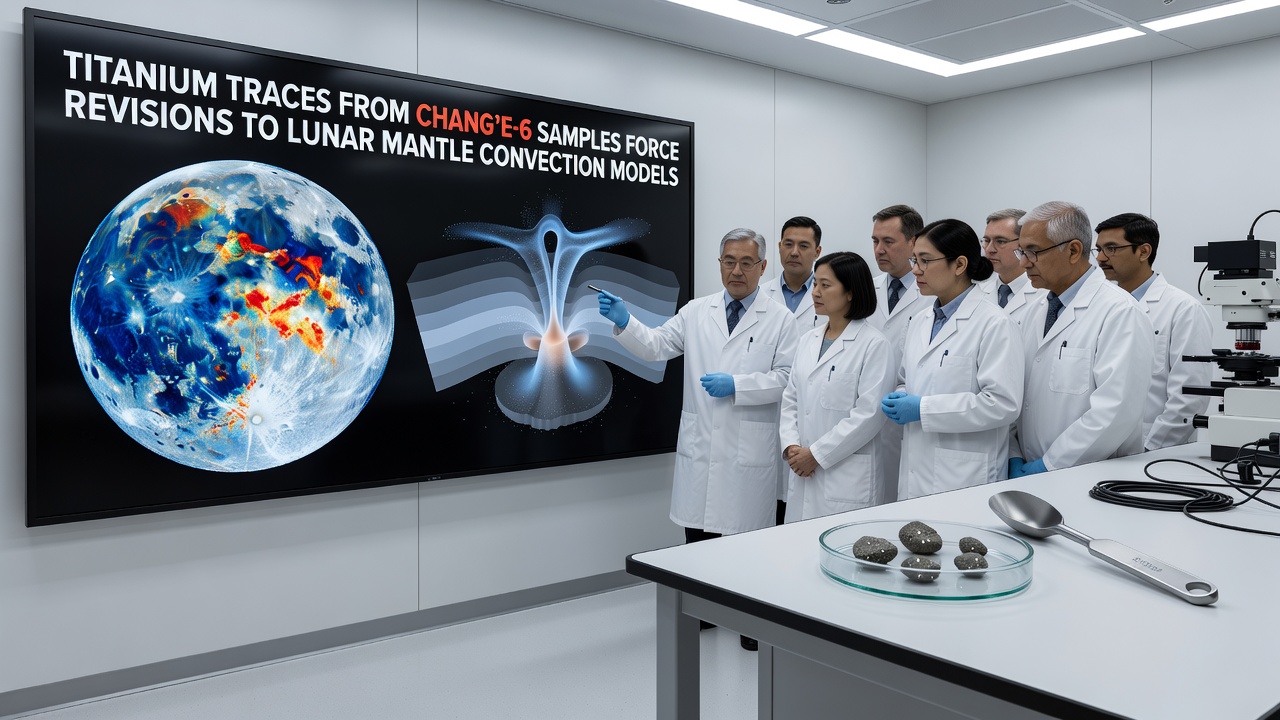
Seismic data from the Apollo Passive Seismic Network already hinted at lateral heterogeneity in the mantle, yet those signals remained ambiguous without direct sample constraints from the far side. The Chang'e-6 results supply missing compositional anchors, and modelers at several institutions now test whether early bombardment or asymmetric tidal heating could have preserved titanium-enriched pockets. One simulation presented at a 2025 planetary science meeting demonstrates that a 20 percent reduction in mantle viscosity allows titanium-rich material to remain buoyant longer, matching the measured concentrations without invoking additional heat sources.
Comparative Studies and Global Context
Teams comparing Chang'e-6 basalts with meteorites from the Moon, such as those recovered in Antarctica, find consistent titanium enrichment patterns in far-side derived specimens, and this convergence strengthens the case for revising global mantle maps. European Space Agency analysts contributed remote-sensing cross-checks from the SMART-1 archive, confirming that titanium anomalies detected from orbit correspond to the sample locations. Meanwhile, NASA-supported researchers at Arizona State University integrate the new data into their thermal evolution codes, and early outputs suggest that far-side volcanism extended later than near-side activity under the updated convection regime.
Additional trace-element ratios, including niobium and tantalum, co-vary with titanium in the Chang'e-6 suite, and these covariations further constrain the degree of partial melting and source depletion. Analysts note that similar ratios appear in some terrestrial flood basalts linked to mantle plumes, although direct analogies remain limited because the Moon lacks plate tectonics. The combined dataset will feed into upcoming workshops scheduled for September 2026, where international modelers plan to benchmark revised convection codes against the full suite of returned samples.
Future Research Directions
Planned follow-on missions, including sample returns from additional far-side sites, will test whether titanium enrichment represents a localized phenomenon or a broader hemispheric signature. Orbital spectrometers on upcoming Chinese and international probes will map titanium at higher spatial resolution, and those maps will guide targeted sampling strategies. Laboratory experiments simulating lunar mantle conditions now incorporate the measured titanium levels to determine melting curves and density profiles under varying pressure and temperature.
Conclusion
The titanium traces recovered by Chang'e-6 have already altered quantitative inputs to lunar mantle convection models, and continued analysis promises further refinements as more data emerge. Integration of these compositional constraints with geophysical observations continues across multiple research centers, and the resulting framework will inform interpretations of mantle dynamics on other terrestrial bodies as well.