Drew Fischer · 19 September 2026
Microbe endurance experiments on simulated lunar soil point to hurdles in establishing self-sustaining habitats
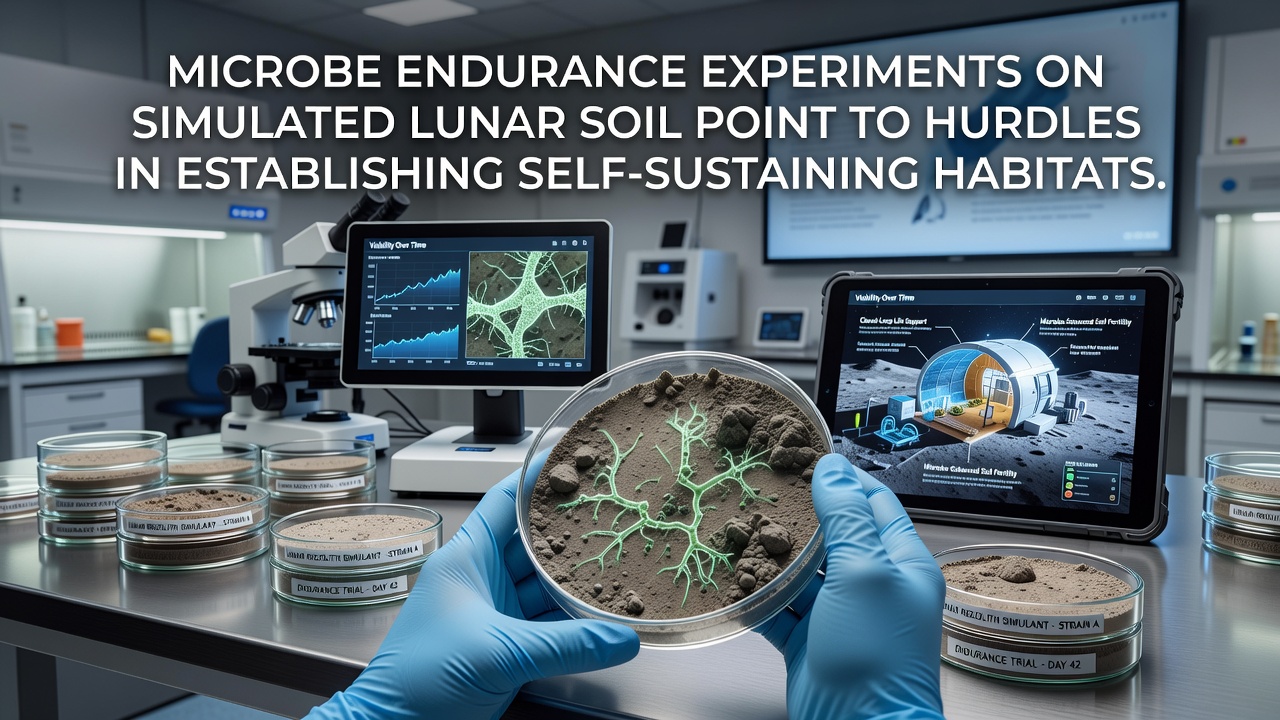
Experiments using microbes exposed to simulated lunar soil have revealed significant challenges for developing self-sustaining habitats on the Moon, with data showing limited survival rates under conditions that mimic lunar regolith composition and radiation exposure. Studies from multiple institutions indicate that common bacterial strains struggle to maintain metabolic activity when placed in mixtures replicating the mineral content found in lunar samples returned by previous missions, and this limitation extends to nutrient cycling processes essential for closed-loop life support systems.
Understanding the experimental setup
Researchers prepared lunar soil simulants using basaltic materials combined with oxides and trace elements to match analyses from Apollo mission collections, then introduced cultures of cyanobacteria and rhizobia in controlled chambers that also incorporated vacuum levels and temperature swings between lunar day and night cycles. Data from these trials, collected over periods ranging from weeks to several months, demonstrate that while some microbes initially colonize the substrate, their populations decline sharply once exposed to ultraviolet radiation levels typical of the lunar surface, and this pattern holds across repeated runs conducted at facilities in both the United States and Europe.
One study tracked gene expression changes in the microbes and found downregulation of pathways involved in nitrogen fixation and photosynthesis, which directly affects the potential for these organisms to contribute to soil fertility in habitat greenhouses. Observers note that the simulants contain high concentrations of iron oxides and perchlorates, compounds that create oxidative stress and disrupt cellular membranes even in hardy extremophiles selected for the tests.
Key findings on microbial survival
Results indicate that survival drops below ten percent within fourteen days under full simulation conditions, whereas control groups kept in standard agar media show stable growth. The addition of organic amendments such as biochar or terrestrial compost improves initial colonization, yet these supplements fail to sustain long-term activity once radiation exposure continues. European Space Agency reports on parallel experiments confirm similar outcomes, with microbial biomass measurements revealing that regolith toxicity remains a primary barrier regardless of species tested.
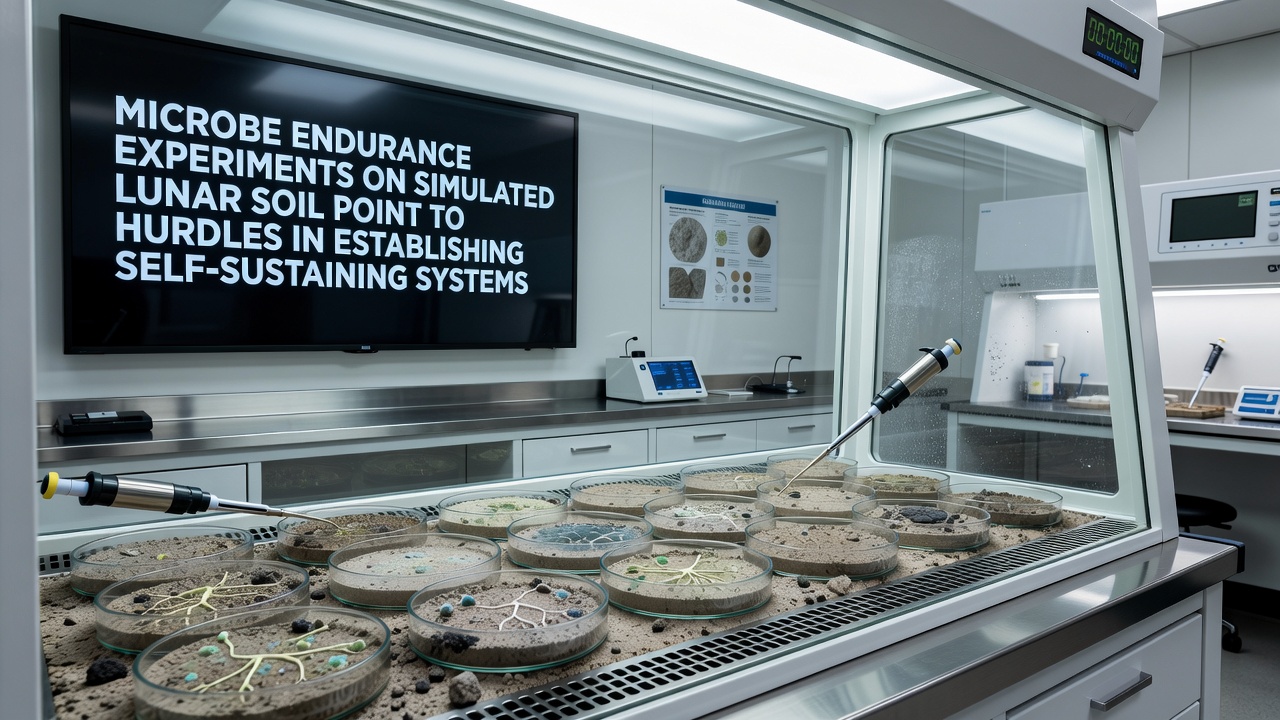
Those conducting the work have also examined interactions between multiple microbial species in mixed communities, and findings suggest that competition for limited resources in the simulant accelerates die-off rather than providing protective effects. Radiation shielding experiments, using thin layers of regolith over culture plates, demonstrate partial protection but still leave populations vulnerable to galactic cosmic rays that penetrate the material over extended periods.
Implications for habitat development
These endurance limitations translate into practical hurdles for self-sustaining habitats, where microbial systems would need to process waste, generate oxygen, and maintain soil health without constant resupply from Earth. Data collected through 2025 shows that current simulant results align with earlier findings from the International Space Station, where microgravity combined with radiation produced comparable stress responses in model organisms. Preparations for additional tests scheduled around September 2026 aim to incorporate improved shielding prototypes and genetically modified strains, yet researchers emphasize that fundamental regolith chemistry issues persist across different experimental designs.
Academic sources including publications from the NASA Lunar Science Program highlight that integration of microbial loops into habitat architectures requires either extensive preprocessing of lunar material or development of strains capable of tolerating perchlorate concentrations exceeding those found in terrestrial deserts. Industry reports from research consortia further note that scaling these systems to support crews of four or more would demand energy inputs for lighting and temperature control that exceed current solar panel efficiencies projected for lunar outposts.
Related research directions
Additional work at universities in Canada and Australia has explored electrokinetic methods to remove toxic ions from simulants before microbial inoculation, and early results indicate modest improvements in survival metrics when electric fields are applied during the first forty-eight hours of exposure. These approaches remain at laboratory scale, however, and translation to field conditions on the Moon would require equipment capable of operating in the abrasive dust environment. Observers note that combining such techniques with selective breeding programs for resilient microbes could eventually reduce dependency on imported soils, although timelines for validation extend well beyond the next decade of planned missions.
Conclusion
Overall the body of evidence from microbe endurance experiments on simulated lunar soil underscores persistent obstacles to establishing self-sustaining habitats, particularly in areas of radiation tolerance, nutrient availability, and long-term population stability. Continued data collection from ongoing and upcoming trials will refine mitigation strategies, yet the core findings point to the need for integrated engineering and biological solutions that address regolith properties directly. Future missions carrying refined payloads stand to provide clearer benchmarks once actual lunar material becomes available for repeated testing under authentic environmental conditions.