Jonas Schmid · 3 October 2026
Shackleton Crater Resource Pacts Shape Plans for Unified Lunar Energy Networks
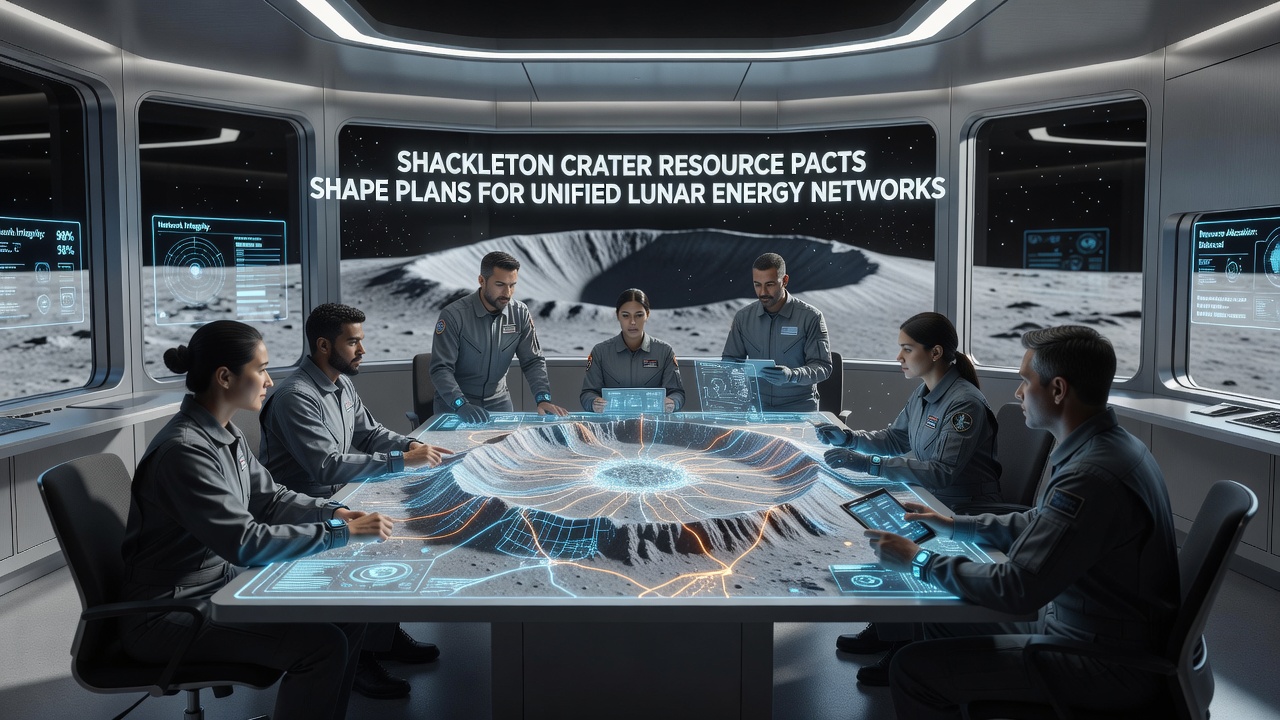
International agreements focused on Shackleton Crater resources have accelerated coordination among space agencies and commercial partners toward integrated lunar power systems, and data from recent orbital surveys indicate that water ice deposits within the crater could support both propellant production and continuous energy generation through solar arrays positioned on crater rims. Those who have tracked these developments note that the pacts emphasize shared extraction protocols while establishing frameworks for transmitting power across multiple surface outposts via high-voltage transmission lines and wireless relay stations.
Resource Agreements and Their Technical Foundations
Negotiations concluded in 2025 between NASA, ESA, JAXA and several private operators produced binding terms for resource allocation at Shackleton, and these documents specify extraction quotas alongside requirements for real-time data sharing on ice purity levels and regolith composition. Figures released by the Lunar Resource Coordination Office show that participating entities committed to joint mapping campaigns scheduled through October 2026, when updated radar and neutron spectrometer readings are expected to refine estimates of accessible water volumes exceeding several billion metric tons. Researchers have observed that such coordinated mapping reduces redundant drilling operations and supports standardized processing techniques for converting ice into liquid hydrogen and oxygen.
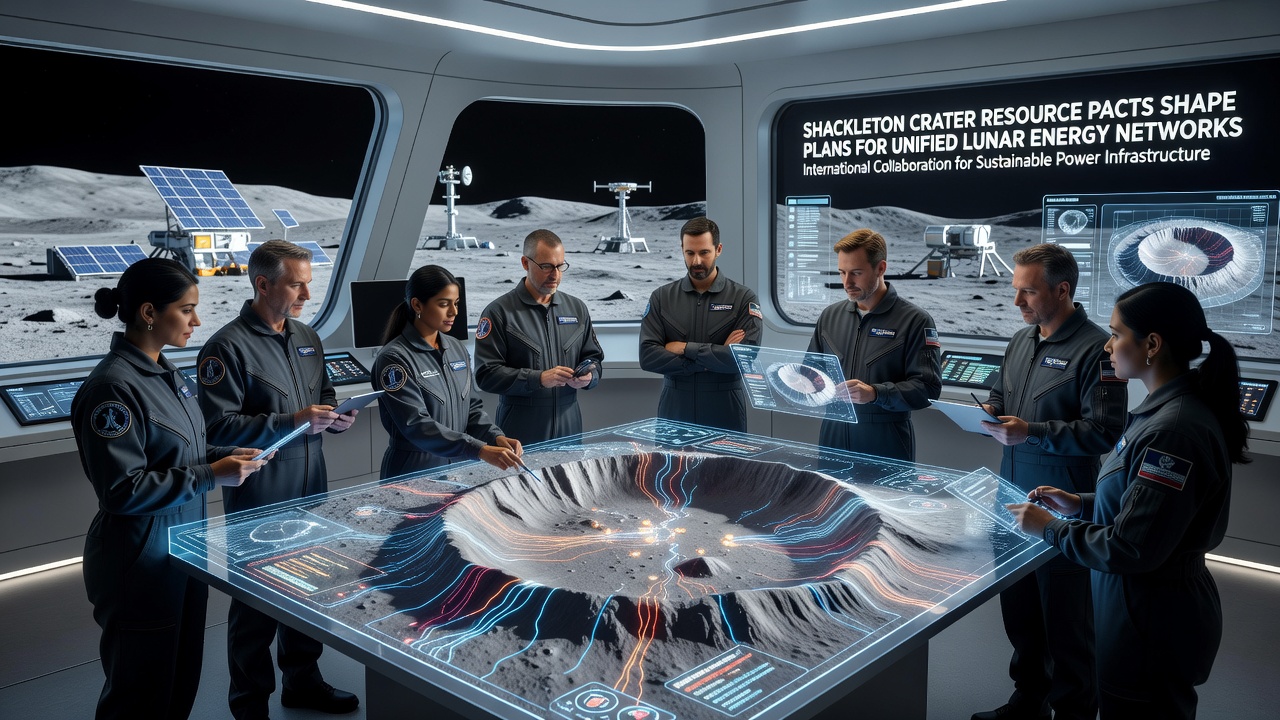
Power distribution concepts emerging from these pacts rely on elevated photovoltaic farms that capture near-constant sunlight on crater rims, while subsurface cables carry energy to habitats and manufacturing facilities located in permanent shadow. One study conducted by the European Space Research and Technology Centre outlined a modular grid architecture capable of scaling from initial 100-kilowatt demonstrations to multi-megawatt networks, and that architecture incorporates fault-tolerant switching stations designed to reroute power during lunar night periods lasting up to 14 Earth days.
International Coordination Mechanisms
Observers note that the agreements include provisions for a unified command center, possibly located at the proposed Lunar Gateway station, where operators would monitor load balancing across separate national modules. Data from the Canadian Space Agency’s power systems laboratory indicates that superconducting transmission lines tested in simulated lunar vacuum conditions can maintain efficiency above 95 percent over distances of several kilometers, a capability that aligns with the grid plans outlined in the Shackleton pacts. Those agreements also establish dispute-resolution procedures for situations where one partner’s resource claim overlaps with another’s planned transmission corridor.
Commercial involvement has introduced additional layers of complexity, because companies such as Blue Origin and ispace have signed memoranda committing to supply regolith-moving equipment in exchange for access to processed volatiles. Yet the pacts require all hardware to meet common interface standards so that power converters and battery storage units from different manufacturers can connect without custom adapters. This standardization effort draws on lessons from the International Space Station electrical systems, where mixed-origin components have operated reliably for decades under similar interoperability rules.
Engineering Challenges and Timeline Milestones
Engineers face significant hurdles related to dust accumulation on solar panels and thermal cycling that stresses cable insulation, and laboratory tests performed at the German Aerospace Center have quantified efficiency losses of up to 30 percent after six months of simulated exposure. The resource pacts therefore mandate regular cleaning cycles using electrostatic repulsion systems and require redundant cable runs buried at least one meter beneath the surface to mitigate micrometeoroid damage. Planning documents indicate that the first operational segment of the unified network could come online by late 2028 if October 2026 mapping data confirms sufficient ice concentrations near proposed drilling sites.
Additional milestones include the deployment of autonomous rovers equipped with ground-penetrating radar to identify optimal cable routes, and these vehicles will operate under shared software protocols developed jointly by the participating agencies. According to preliminary simulations released by the Japan Aerospace Exploration Agency, a ring-shaped transmission loop around the crater rim could deliver uninterrupted power to six separate landing zones while minimizing voltage drop across the network.
Future Implications for Broader Lunar Infrastructure
Analysts tracking these developments point out that successful implementation at Shackleton could serve as a template for similar resource-sharing arrangements at other permanently shadowed craters, and such expansion would support larger-scale scientific installations including radio telescopes and particle detectors that require stable electrical supply. The pacts contain language encouraging technology transfer to emerging spacefaring nations, which could accelerate global participation in lunar energy projects once initial infrastructure proves reliable.
Regulatory bodies in multiple regions continue to review the legal status of extracted resources under existing space treaties, yet the Shackleton agreements include clauses that defer final ownership determinations until operational data clarifies extraction yields and processing efficiencies. This approach allows construction to proceed while broader policy discussions continue in parallel forums.
Conclusion
The resource pacts centered on Shackleton Crater have already produced concrete engineering specifications and shared testing schedules that together point toward a functioning lunar energy grid within the next decade. Continued data collection through October 2026 and beyond will determine whether projected ice volumes and power transmission performance meet the thresholds required for sustained multi-partner operations. Those following these developments will watch closely as hardware integration tests transition from Earth laboratories to the lunar surface itself.