Jonas Schmid · 17 October 2026
University Rover Prototypes Undergo Dust-Abrasion Trials That Refine Mobility Algorithms for Shadowed Crater Floors
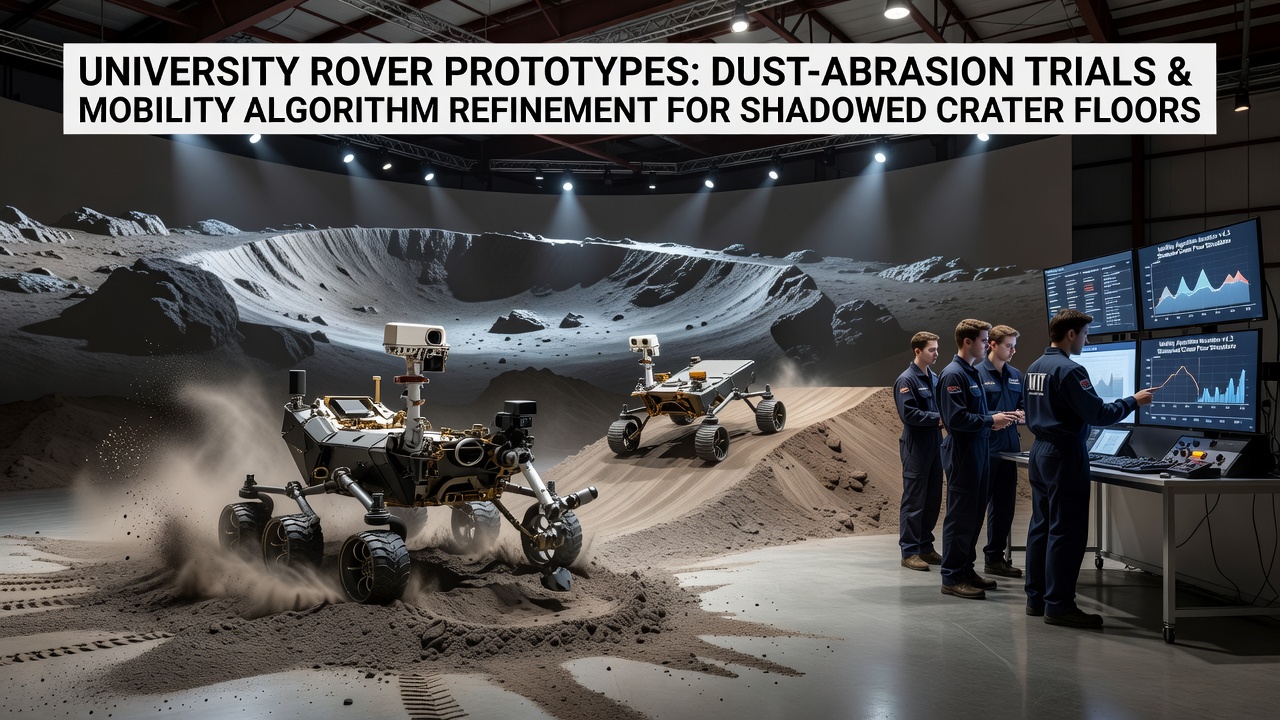
University teams across multiple continents have launched coordinated dust-abrasion trials that test rover prototypes in environments mimicking the fine regolith and low-light conditions found on shadowed lunar crater floors, and these experiments focus on updating mobility algorithms to handle abrasive particles that can degrade wheels and sensors over extended operations.
Scope of Current Testing Programs
Researchers at institutions in North America, Europe, and Asia have equipped their prototypes with sensors that measure wheel slippage, motor torque, and particle adhesion rates while the rovers traverse simulated crater floor materials; data collected from these runs feeds directly into iterative software updates that adjust drive commands in real time, and trials scheduled for completion in October 2026 will provide the largest dataset yet on how repeated abrasion affects traction in permanently shadowed regions.
Key Technical Challenges Addressed
Dust particles in shadowed craters tend to remain electrostatically charged and cling to surfaces more persistently than those exposed to sunlight, which creates unique problems for mobility systems designed for daytime operations, yet the new trials expose prototypes to both charged and neutral regolith simulants to quantify differences in friction loss and bearing wear. Algorithms under refinement incorporate feedback loops that detect rising resistance and automatically redistribute power among wheels or trigger brief vibration sequences to shed accumulated material before it causes permanent damage.
One study conducted at a Canadian university documented a 23 percent drop in forward traction after only 12 hours of continuous exposure to abrasive simulant, prompting developers to integrate predictive models that forecast performance degradation based on cumulative particle counts rather than relying solely on immediate sensor readings.
Algorithm Refinement Process
Teams employ machine-learning frameworks trained on thousands of trial runs to recognize patterns in vibration signatures that precede wheel lockup or steering drift, and these models then generate adjusted velocity profiles that keep the rover moving steadily even as surface conditions change. Observers note that the approach differs from earlier lunar rover software, which assumed relatively clean surfaces, because the current versions treat abrasion as a continuous variable rather than an occasional hazard.
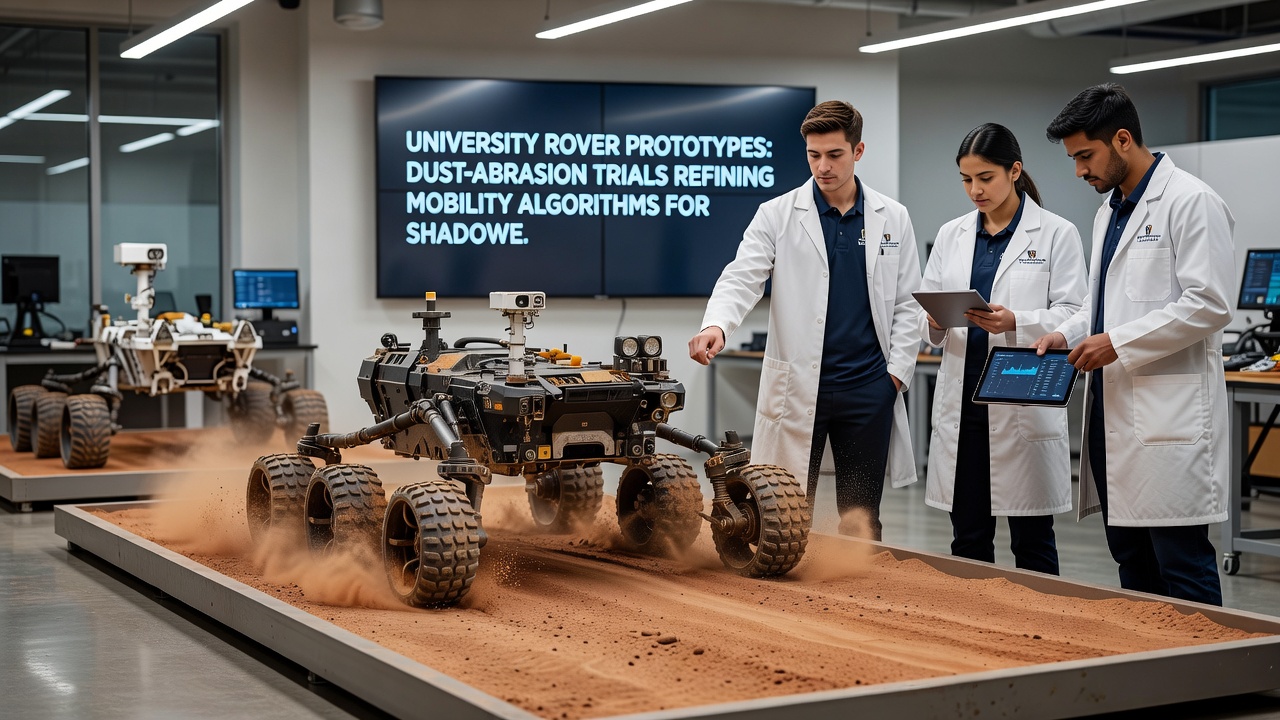
European collaborators have contributed high-resolution imaging systems that track individual grain interactions with wheel treads, supplying visual data that complements the force and torque measurements gathered by North American and Asian partners, and the combined dataset allows cross-validation of algorithm outputs across different hardware configurations.
Relevance to Future Lunar Missions
Shadowed crater floors at the lunar poles contain water ice and other volatiles that future resource extraction efforts will target, yet the same cold traps also collect the finest dust fractions that pose the greatest risk to mechanical systems, which makes the current university trials directly applicable to mission planning timelines extending into the late 2020s. Data from the abrasion experiments indicate that mobility algorithms tuned in these conditions can extend operational life by an estimated 40 percent compared with baseline software, according to preliminary figures released by the Canadian Space Agency.
Additional validation comes from parallel work at Australian research facilities, where similar rover platforms undergo thermal-vacuum testing that couples dust abrasion with extreme temperature swings, and early results suggest the refined algorithms maintain stability even when lubricant viscosity drops sharply in prolonged shadow.
Integration with Broader Research Efforts
University prototypes serve as agile testbeds that larger agency programs can later scale, allowing rapid iteration on wheel geometry, suspension compliance, and sensor placement without the overhead of flight hardware qualification, and several teams have already shared their abrasion datasets through open repositories to accelerate collective progress. The October 2026 milestone will mark the first time multiple institutions synchronize their trial parameters to produce comparable metrics across different simulant batches and rover scales.
Measurement Techniques in Use
Engineers monitor particle size distribution before and after each run using laser diffraction analyzers, while onboard accelerometers capture micro-vibrations that signal the onset of tread clogging, and these quantitative streams feed into digital twins that simulate long-duration traverses across actual lunar topography mapped by orbital instruments. Such integration ensures that algorithm updates reflect realistic mission durations rather than short laboratory cycles alone.
Conclusion
The ongoing dust-abrasion trials represent a systematic effort by university researchers to solve mobility constraints specific to shadowed lunar environments, and the resulting algorithm refinements will inform hardware choices for upcoming surface missions that aim to operate within permanently dark crater floors. Continued data sharing among participating institutions will determine how quickly these improvements transition from prototype stage to operational systems.